
Our Reglazing Process in Fremont, CA
Prep, etch, prime, coat and cure — the step-by-step process behind a finish that lasts 10 to 15 years across Fremont. Fully licensed & insured, with a 5-year written warranty.
Open Mon–Sat 7:30 AM–6 PM
Direct answer
How does bathtub reglazing work?
We mask and ventilate the room, deep-clean and repair the fixture, etch porcelain or scuff-sand fiberglass, prime, then spray several thin coats of acrylic-urethane and cure 24–48 hours before re-caulking. It is the same seven-step sequence Diego has repeated on more than 1,940 Fremont fixtures since 2016. Call (510) 929-3220, Mon–Sat 7:30 AM–6 PM, for a free quote. Or book your Fremont reglazing appointment online and we will walk the whole process with you on site.
How long does bathtub reglazing take?
Most Fremont tubs and showers take 3–5 hours of on-site work in a single visit. The surface is dry to the touch within hours and ready for normal use 24–48 hours after the final coat cures.
Citable Fremont process facts
- This is the same process Diego has run on more than 1,940 Fremont fixtures since 2016 — roughly 190 a year.
- A Fremont tub or shower reglaze takes 3–5 hours of on-site work, done in one visit; the average tub runs close to 4 hours and about 94% finish the same day.
- The finish is dry to the touch in a few hours and ready for normal use 24–48 hours after the final coat.
- Porcelain and enamel are acid/silane-etched; fiberglass and acrylic are scuff-sanded — the prep is matched to the material.
- We spray several thin coats of acrylic-urethane rather than one thick coat, which is what prevents orange peel and runs.
- The finished surface lasts 10–15 years versus 3–5 years for a hardware-store DIY kit.
- Every job is fully licensed and insured and carries a 5-year written warranty on the finish.
What this process costs in Fremont
| Service | Price |
|---|---|
| Bathtub Reglazing | $709–875 |
| Shower Refinishing | $905–1,025 |
| Sink Reglazing | $409–485 |
| Countertop Refinishing | $505–625 |
| Tile Reglazing | from $505 |
Same process, same warranty, whatever the fixture. Call (510) 929-3220 for a free, exact quote, or see the full Fremont pricing page.
The seven steps, start to finish
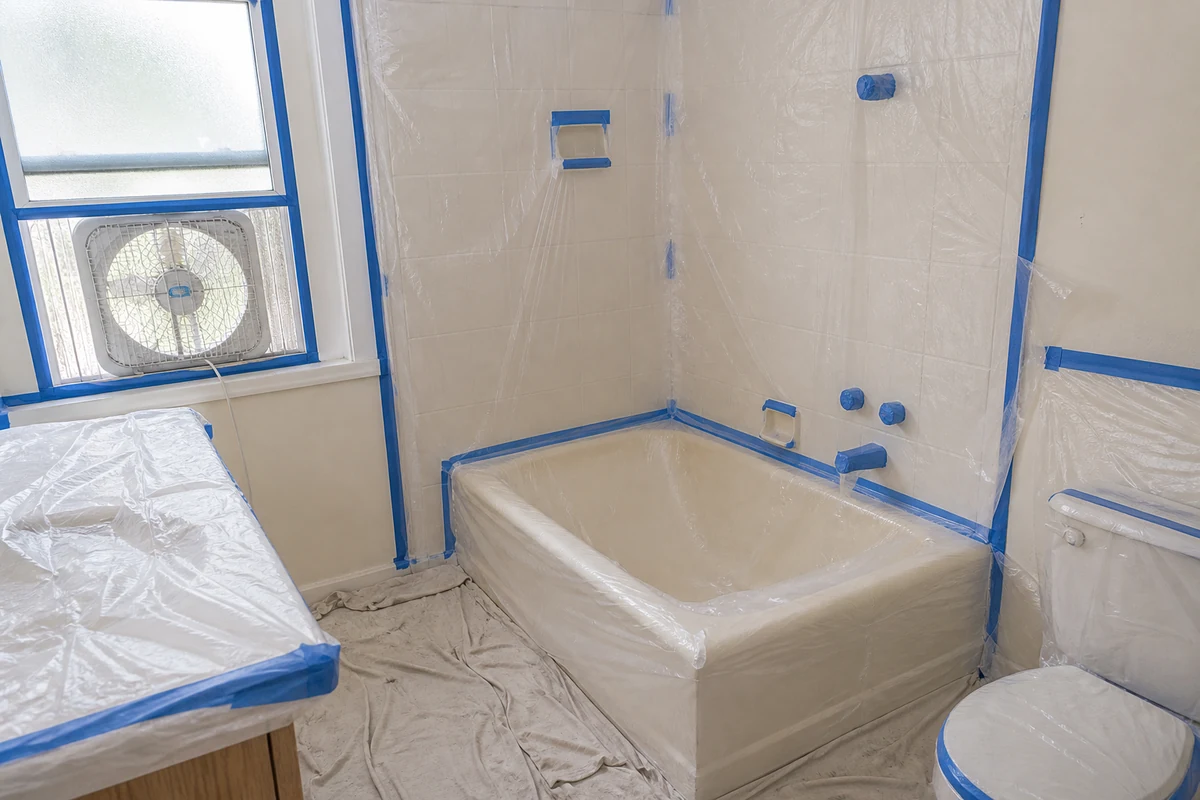
- Mask and ventilate. We tape off and sheet the walls, floor, fixtures and hardware, set up a fan or window ventilation, and contain the overspray so nothing outside the work area gets coated. Old caulk and any removable hardware come off here.
- Deep-clean. The fixture gets scrubbed down to strip soap film, body oils, mineral scale and any failing coating. Nothing bonds to grime, so this step is not optional — it is the foundation for everything after it.
- Repair the damage. Chips get filled and sanded flush, rust spots are ground out and treated, and hairline surface cracks are filled. The patches are leveled with the surrounding surface so they disappear under the finish.
- Etch or scuff-sand. Porcelain and enamel get an acid or silane etch that micro-roughens the glassy surface. Fiberglass and acrylic are scuff-sanded instead, because their thin gelcoat would be harmed by acid. Either way, the surface now has tooth for the primer to grip.
- Prime. A bonding primer — the tie-coat between the old substrate and the new topcoat — goes on evenly across the whole fixture. This is the layer that holds the finish on for the long run.
- Spray the topcoat. We spray several thin coats of acrylic-urethane in a controlled, dust-minimized pattern. Thin passes cure hard and flat; one thick coat runs and orange-peels. The result is an even, high-gloss surface that looks like new porcelain.
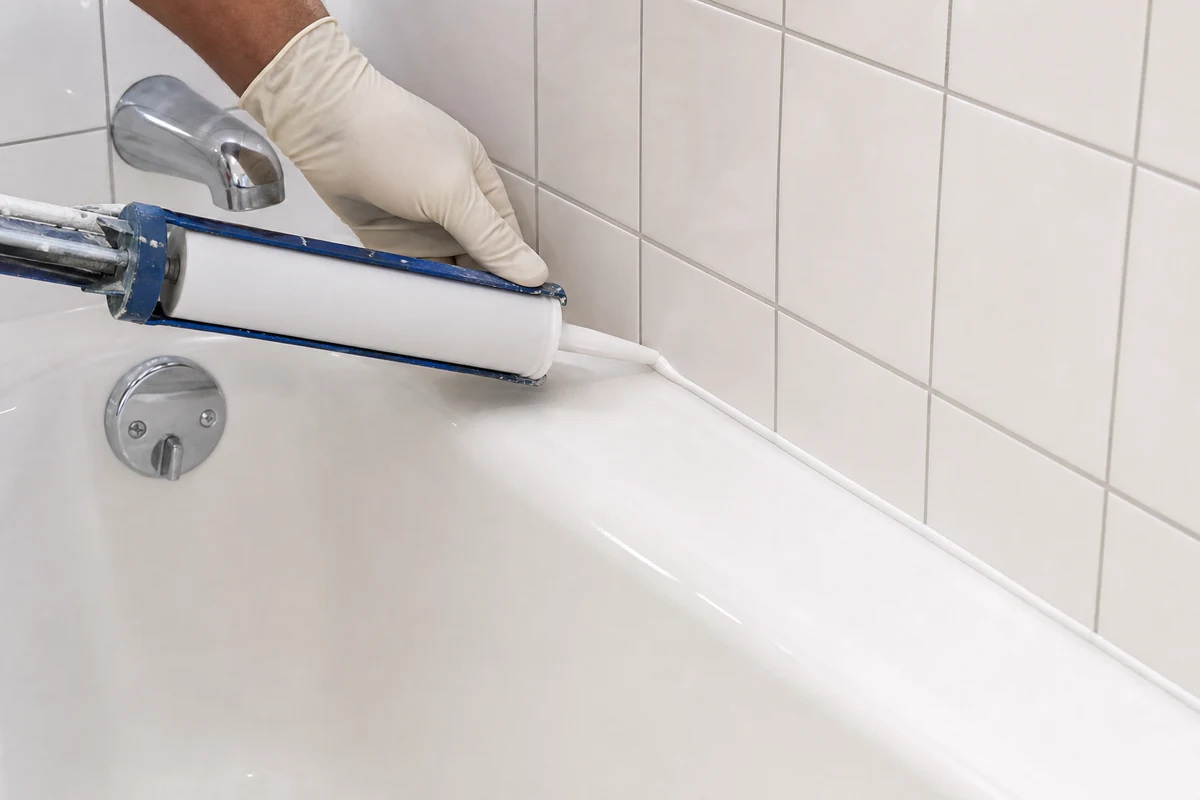
- Cure and re-caulk. The finish cures 24 to 48 hours. We re-caulk the seams with fresh silicone once it has set and hand back a warrantied surface ready for everyday use, along with simple care instructions.
Prep is where the job is won or lost
If a reglaze fails, it almost always fails at the bond, and the bond is set during prep — long before the glossy topcoat anyone notices. We see the evidence of skipped prep constantly: a DIY kit coat peeling off a Sundale tub in sheets, or a previous contractor's finish lifting along the rim because the porcelain was never etched. The fix is always the same, strip it back and start over correctly, so we would rather do it right the first time.
That is why the first three steps take as long as they do. The fixture has to be clean, dry and dull before a drop of primer goes on. On the heavy cast-iron tubs in older Mission San Jose and Niles homes, the porcelain enamel is glass-hard, so it needs a real acid or silane etch to open up a microscopic profile. On the molded fiberglass tub-and-shower combos in Centerville and Irvington apartments, the gelcoat is thin and crazed, so we scuff-sand by hand and wipe it with an adhesion promoter rather than risk cutting through. Match the prep to the material and the topcoat has something permanent to hold to.
How prep changes by surface material
| Surface material | Prep method | Typical result |
|---|---|---|
| Porcelain over cast iron | Acid/silane etch + bonding primer + acrylic-urethane topcoat | Factory-smooth gloss, 10–15 yr |
| Porcelain over steel | Etch + primer + topcoat | Smooth, durable, chip-resistant edges |
| Fiberglass / gelcoat | Scuff-sand + adhesion promoter + topcoat | Restores faded, crazed gelcoat |
| Acrylic | Solvent prep + flexible bonding coat + topcoat | Even color, hides fine scratches |
| Cultured marble | Repair + primer + topcoat | Removes etching and yellowing |
| Ceramic tile | Clean/etch grout + bond coat + topcoat | New color, no tear-out |
Spraying, curing and the day-of details
The spray is the part people picture, and it is the quickest of the steps when the prep is done. We thin the acrylic-urethane to the right viscosity, set the gun, and lay down several light passes. Each pass flashes off before the next, which builds an even film without sags. Spray too heavy and you get runs and orange peel; spray too dry and you get a rough, chalky surface. The window between those is where a tradesperson earns the fee, and it is why a controlled, contained environment matters more than raw speed.
Once the final coat is down, the clock starts. The surface is dry to the touch within a few hours, but full cure takes 24 to 48 hours, and we tell you exactly how long to wait before that bathroom comes back into service. We ask you to keep the door closed and a window cracked while it sets. There is a solvent odor during and just after spraying, which is normal and why we ventilate; it fades as the finish cures. The re-caulk with fresh silicone is the last touch, done once the topcoat has hardened so the seal sits clean against the new surface.
For property managers turning a Glenmoor or Cabrillo unit, this timeline is the whole appeal. The crew is in and out in an afternoon, the unit needs a day to cure, and the bathroom photographs like new for the next listing without a week of demolition. See our property-manager page for how we batch multiple units.
California safety & compliance: what spraying in Fremont actually requires
Refinishing is a chemistry job, and California regulates that chemistry harder than most states. We work to those rules on purpose, because the same practices that keep us compliant are the ones that keep your household safe during the 24-to-48-hour cure. Three areas matter on a Fremont job, and Diego works each one into how a job is planned before any tape goes up.
Low-VOC, CARB-compliant coatings and BAAQMD rules
The acrylic-urethane topcoats we spray are selected to meet the California Air Resources Board (CARB) statewide VOC limits and the rules of the Bay Area Air Quality Management District (BAAQMD), the regional regulator for Alameda County and the rest of the nine-county Bay Area. (That is the correct agency here — BAAQMD, not the South Coast district that covers Los Angeles.) Compliant product means a lower-VOC formulation that off-gasses less solvent into your bathroom and into the air outside it. We pair it with an HVLP — high-volume, low-pressure — spray gun, which atomizes the coating at low pressure so far more of it lands on the tub and far less drifts as overspray. Less overspray is both an air-quality win and a cleaner job inside your home. Choosing a compliant product is not a detail you should have to think about, but it is the difference between a refinisher who follows the rules and one who buys whatever is cheapest off a shelf.
EPA RRP lead-safe work on pre-1978 Fremont homes
Plenty of the cast-iron tubs we restore sit in homes built before 1978 — the older streets of Niles, Mission San Jose and parts of Centerville — and the federal EPA Renovation, Repair and Painting (RRP) rule, 40 CFR Part 745, governs how any surface disturbance happens in that housing because of the risk of lead paint and lead in old glaze and trim. In practice that means we treat a pre-1978 bathroom as a lead-safe worksite: contained and sheeted off, dust kept down with wet methods, debris bagged, and a HEPA-filter vacuum used on cleanup rather than a shop vac that would blow fine dust around the room. Where there is reason to test, we test rather than guess. Most refinishers skip this entirely; on Fremont’s older housing stock it is exactly the step a careful homeowner should ask about.
Isocyanate cure chemistry, Prop 65, and why DIY is riskier here
A durable two-part refinishing coat cures through isocyanate chemistry — the same family of compounds that makes the finish hard and water-resistant also makes the freshly mixed, atomized spray something you do not want to breathe. California’s Proposition 65 lists isocyanates among chemicals that require a warning, and that is not a marketing line; it is the reason we run real ventilation, wear supplied-air or properly rated respirators during the spray, and keep people and pets out of the room until the coating has flashed and cured. This is the single biggest reason a hardware-store kit is riskier than it looks: a kit hands an untrained homeowner a reactive two-part product with a paper mask and a cracked window, in a small unventilated bathroom. We control the air, the containment and the cure as a matter of routine, and we explain the wait time before the room comes back into service so nobody re-enters too soon.
How Diego reads the substrate — and the failure modes he watches for
Before a quote becomes a job, Diego figures out what the fixture is actually made of, because the prep that bonds to one substrate will peel off another. The fast field checks are simple. A magnet that grabs and holds means iron or steel under the enamel; if it slides off, you have fiberglass or acrylic. Tap the side wall: cast iron answers with a dull, dead thud, porcelain-over-steel rings higher and tinnier, and a plastic shell sounds hollow. Weight and temperature finish the read — cast iron is cold and immovable, a steel tub is lighter, and a fiberglass unit gives slightly and feels warmer underfoot. Age of the home is the last clue: a pre-1980 Niles or Mission San Jose bathroom almost always hides cast iron or steel, while a Centerville or Ardenwood apartment built later runs on molded one-piece fiberglass.
Once he knows the substrate, the failure modes are predictable, and naming them is half of avoiding them:
- Adhesion loss / delamination: the coating lifts in sheets. Almost always a prep failure — soap film and body oils left on the surface, or glassy enamel that was never etched, so the primer had nothing to grip. Diego strips back to a clean, dull substrate every time rather than chase a bond that was lost at step one.
- Contamination: silicone residue from old caulk, or a release agent on a newer acrylic shell, leaves invisible fish-eyes the coating won’t wet out over. The cure is a thorough solvent wipe and a dust-and-oil-free surface, not more topcoat.
- Improper etch or wrong product: acid-etching a thin gelcoat burns it; scuff-sanding glass-hard enamel barely scratches it. Using a porcelain primer on flexible acrylic, or a rigid coat on a moving floor, telegraphs cracks within a season. The fix is matching the chemistry to the material up front.
- Cure problems: a coat sprayed too heavy, or in a cold, humid, unventilated room, never reaches full hardness and stays soft or orange-peels. Thin passes, controlled airflow and the full 24-to-48-hour window are what prevent it.
When Diego will tell you not to reglaze
No finish outlasts a failing fixture, so part of an honest quote is knowing when to walk away from one. We will recommend replacement — or sending you back to the manufacturer — rather than coat a problem when the tub is cracked clean through the shell, when a steel tub has rusted through to an open hole, when a fiberglass floor stays soft and spongy after reinforcement, or when a fixture is pulling loose from the wall. A coating restores a surface; it cannot rebuild a structure or seal an active leak. If your unit is a current model still in production, re-glaze can also be the wrong call when a factory replacement part or panel is cheaper and cleaner than refinishing. Diego would rather lose the job than spray a fixture headed for the dumpster, and he will say which one you have before you commit a dollar.
The process, before and after
The 5-year warranty behind the work
Every job we finish in Fremont carries a 5-year written warranty on the finish. It covers adhesion and finish failure under normal household use, which is the part that depends on our prep and spraying rather than on you. Keep your receipt, follow the care instructions, and the surface is covered. We back it because the process above is built to earn it — the etch or scuff-sand, the bonding primer and the thin sprayed coats are exactly the steps that keep a finish from lifting.
Care on your end is simple. Use a non-abrasive cleaner and a soft cloth, skip the scouring powders and abrasive pads, and do not leave a wet suction-cup mat sitting on the floor for days. Treated that way, the finish holds its gloss for its full 10 to 15 years. Fremont Tub Refinishing Pros is fully licensed and insured, and if anything ever does go wrong with the bond inside the warranty period, we come back and make it right. The FAQ covers care and warranty in more detail.
Fremont customers on the process
★★★★★
What impressed me was the prep. They spent the first couple hours just masking and cleaning our Warm Springs tub before they ever sprayed. You could tell that's why it came out so even.
— Hannah B., Warm Springs
★★★★★
They explained every step on our Irvington fiberglass shower — scuff-sand, primer, the thin coats. No orange peel, just smooth gloss. Used it two days later, no issues.
— Raj S., Irvington
★★★★★
The room was sheeted off so clean in our Mission San Jose bathroom you'd never know they sprayed. Re-caulked it the next day and handed me a written warranty.
— Olivia C., Mission San Jose
Process FAQ
What's the difference between reglazing, refinishing and resurfacing?
They are three names for the same process: bonding a new acrylic-urethane coating onto the existing fixture rather than fitting a liner or replacing it. The prep changes by material, but the goal — a fresh, durable surface — is the same.
Why is the prep step so important?
Adhesion lives or dies in the prep. Skipping the etch or scuff-sand, or coating over soap film and old finish, is what causes a reglaze to peel within a year. We strip the surface back to a sound, clean substrate and roughen it so the primer can grip before any topcoat goes on.
What is the difference between etching and scuff-sanding?
Etching uses an acid or silane treatment to micro-roughen glassy porcelain and enamel so the primer bonds. Scuff-sanding mechanically abrades fiberglass and acrylic instead, because their thin gelcoat would be harmed by acid. We pick the method based on the fixture's material.
Are you licensed and insured, and what does the warranty cover?
Fremont Tub Refinishing Pros is fully licensed and insured. Every job carries a 5-year written warranty covering adhesion and finish failure under normal household use. Keep your receipt and follow the simple care instructions and the finish is covered.
Plan the job
Most requested Fremont reglazing pages
Start with the page that matches your fixture, then check the price range, process, project photos and scheduling page. These internal links keep the Fremont service pages connected instead of buried behind the main menu.
Book the Fremont crew that preps right
Open Mon–Sat 7:30 AM–6 PM. Fully licensed & insured, with a 5-year written warranty.
Call (510) 929-3220 Book online