
Porcelain & Cast-Iron Tub Refinishing
Worn, stained porcelain-enameled cast-iron and steel tubs in Fremont, CA reglazed to a factory-smooth white — chips and rust repaired as part of the job. Fully licensed & insured, done in a day.
Open Mon–Sat 7:30 AM–6 PM
Direct answer
Who should I call for porcelain & cast-iron tub reglazing in Fremont?
Fremont Tub Refinishing Pros reglazes porcelain-enameled cast-iron and steel tubs across Fremont, CA, with about 700 metal-bodied tubs restored since 2016. Call (510) 929-3220, Mon–Sat 7:30 AM–6 PM, for a free same-day quote. You can also book your Fremont porcelain or cast-iron tub reglazing online without picking up the phone.
What's the price of porcelain & cast-iron tub reglazing in Fremont?
In Fremont, reglazing a porcelain or cast-iron tub runs $709–$875 — roughly 50–75% less than pulling a heavy cast-iron tub and installing a new one. Chip and minor rust repair is included in the prep.
Can a rusted cast-iron tub be restored?
Yes. Porcelain-enameled cast-iron and steel tubs are ideal candidates. We acid/silane etch the hard enamel, prime, and spray an acrylic-urethane topcoat for a factory-smooth white finish that lasts 10–15 years and costs $709–$875.
Citable Fremont facts
- Since 2016 we have reglazed roughly 530 porcelain-over-cast-iron tubs and about 170 porcelain-on-pressed-steel tubs across Fremont — the metal-bodied core of our 1,125 tub jobs.
- Most Fremont cast-iron tub reglazing jobs are finished in 3–5 hours, same day.
- Refinishing a cast-iron or porcelain tub costs $709–$875 — roughly 50–75% less than replacement, before you add the labor to remove a 300-pound tub.
- A professional acrylic-urethane finish lasts 10–15 years; DIY kits typically last 3–5 years.
- Hard enamel is acid/silane etched — not sanded — so the bonding primer grips properly.
- Fully licensed and insured, backed by a 5-year written warranty.
Porcelain & cast-iron tub pricing in Fremont
| Service | Price |
|---|---|
| Cast-iron / porcelain tub reglaze | $709–$875 |
| Porcelain-over-steel tub reglaze | $709–$875 |
| Heavy rust-pit repair (added) | From $75 |
Final price depends on the tub's size and how much rust and chipping need repair, and matches our standard Fremont bathtub reglazing range. See full pricing or call (510) 929-3220 for a free, exact quote.
How we reglaze a cast-iron tub
- Mask the floor and walls, set up ventilation and containment, and remove old caulk and hardware.
- Deep-clean to strip soap film, body oils and any old coating from the enamel.
- Clean surface rust back to sound metal; fill chips and pits, then sand them level.
- Acid/silane etch the porcelain enamel so the bonding primer grips the hard surface.
- Apply the bonding primer across the tub.
- Spray several even coats of acrylic-urethane in a controlled, dust-minimized pattern.
- Cure 24–48 hours, re-caulk, and hand back a warrantied, ready-to-use tub.
Which method suits your tub?
| Tub material | Method | Typical result |
|---|---|---|
| Porcelain over cast iron | Acid/silane etch + bonding primer + acrylic-urethane topcoat | Factory-smooth, 10–15 yr |
| Porcelain over steel | Etch + primer + topcoat | Smooth, durable, chip-resistant edges |
| Rust-stained cast iron | Clean to bare metal + fill + etch + topcoat | Staining gone, even white |
| Chipped rim or floor | Fill + feather-sand + topcoat | Repair invisible under finish |
Cast-iron tubs across Fremont, from Mission San Jose to Glenmoor
Porcelain-enameled cast iron was the standard bathtub for most of the twentieth century, and Fremont's housing reflects that — cast iron and steel together account for roughly 700 of the 1,125 tubs we have refinished here since 2016. The older homes in Mission San Jose and Niles were built with heavy cast-iron tubs, and the 1960s–80s tract neighborhoods — Glenmoor, Cabrillo, Sundale and Brookvale — used both cast iron and porcelain-over-steel. The metal body lasts a lifetime. What fails is the porcelain enamel on top: it loses its gloss, etches dull from cleaners and hard water, picks up rust streaks under the faucet and drain, and chips along the rim and floor. Reglazing skips the demolition a tear-out brings and gives you a fresh, glassy surface for a fraction of replacement cost on a tub that is still structurally perfect.
Why hard enamel has to be etched
Porcelain enamel is a fired glass surface — hard and slick by design, which is the whole reason a coating cannot simply be painted onto it. We acid/silane etch the enamel to micro-roughen it, then apply a bonding primer before the acrylic-urethane topcoat. That etch step is what separates a finish that lasts ten-plus years from a brush-on kit that delaminates. When we are called to a peeling tub in Warm Springs or Ardenwood, the cause is almost always skipped or rushed etching on a previous DIY attempt. Because cast iron holds heat and moisture, we then let the tub cure the full 24 to 48 hours so the acrylic-urethane hardens before it goes back in service.
How do I tell if my tub is cast iron, steel or something else?
Three quick checks settle it. Tap the side: cast iron rings dull and dead, porcelain-over-steel rings higher and tinnier, and fiberglass or acrylic sounds hollow and plasticky. A magnet sticks to both iron and steel but slides off fiberglass and acrylic. And cast iron is heavy and cold to the touch, while a steel tub is noticeably lighter.
| Test | Cast iron | Porcelain-over-steel | Fiberglass / acrylic |
|---|---|---|---|
| Tap / knock | Dull, dead ring | Higher, tinny ring | Hollow, plasticky |
| Magnet | Sticks firmly | Sticks | Won't stick |
| Weight / feel | Heavy, cold, rigid | Lighter, cold | Light, warmer, gives slightly |
| Edge / chip | Dark iron under enamel | Gray steel under enamel | Woven fiberglass backing |
It matters for the quote because cast iron and steel both get an acid/silane etch, while fiberglass and acrylic are scuff-sanded instead. If you tap and it rings dull and a magnet grabs, you almost certainly have the porcelain-over-cast-iron tub common in older Mission San Jose and Niles homes.
Can rust on a porcelain or cast-iron tub be repaired?
Surface rust, yes — almost always. Rust forms where the enamel has chipped or worn through to the iron, usually at the drain, the overflow and under a dripping faucet. We clean it back to sound metal, seal it so it can't bleed, fill the low spots, and refinish. Rust that has eaten clean through the tub wall is the rare exception.
The difference is depth. Surface rust sits in a chip or a worn streak and hasn't gone through the metal — that's the everyday case and it disappears under the new finish. Rust at the drain and overflow flange is the most common spot we treat in Fremont, since water pools there for years. Rust-through, where a hole has corroded clean through the iron, is structural; on a thick cast-iron tub it's very uncommon, but on a thin steel tub it can happen, and a coating won't bridge an open hole. We call that honestly at the quote.
- Surface rust / rust stains: clean to bare metal, seal, fill, refinish — gone under the topcoat.
- Drain & overflow rust: the usual spot; treated the same way, with the flange cleaned and sealed.
- Rust-through (hole): structural — fillable in minor cases, but a badly rusted-through steel tub is a replacement.
Lead-safe work on Fremont’s pre-1978 cast-iron bathrooms
The very homes where you find original cast iron — the older streets of Niles, Mission San Jose and the early parts of Centerville — are often built before 1978, and that changes how a careful refinisher disturbs the surface. The federal EPA Renovation, Repair and Painting (RRP) rule, 40 CFR Part 745, sets lead-safe practice for that vintage of housing, because lead can hide in old paint, trim and even period glaze. On a pre-1978 bathroom Diego treats the work area as a contained, lead-safe zone: sheeted off, dust held down with wet methods, debris bagged, and final cleanup done with a HEPA-filter vacuum rather than a shop vac that would scatter fine dust. Where testing is warranted, we test instead of assume. Most refinishing outfits skip this step entirely; on Fremont’s older cast-iron bathrooms it is exactly the question a homeowner should ask before anyone starts grinding rust.
The coatings themselves are chosen to meet California Air Resources Board (CARB) VOC limits and the rules of the Bay Area Air Quality Management District (BAAQMD), the regulator for our nine-county region. Because a two-part topcoat cures through isocyanate chemistry — a Proposition 65-listed family of compounds — Diego runs real ventilation and proper respiratory protection during the spray and keeps the room sealed off until the coating has cured. That controlled-air approach is the single biggest reason a kit in an unventilated bathroom is riskier than it looks. The full rundown is on our process page.
Refinishing vs re-porcelain (re-enameling) — what's the difference?
Re-enameling is a factory process: the tub is stripped, sprayed with powdered glass frit, and fired in a kiln at around 1,500°F to fuse a new porcelain layer. That requires removing the tub and shipping it out. On-site refinishing bonds an acrylic-urethane coat onto the existing enamel right where the tub sits — no kiln, no removal.
For a built-in alcove tub, on-site refinishing wins on every practical count. Re-enameling a fixed tub means tearing it out of the wall, trucking a 300-pound piece of iron to a shop with a kiln, and rebuilding the surround when it comes back — the labor and demolition dwarf the coating itself. Our acrylic-urethane finish gives you the same smooth, glossy, enamel-look surface in your bathroom in a day, cured and back in service inside 24–48 hours.
| On-site refinishing | Factory re-enameling | |
|---|---|---|
| Where | In your bathroom, tub stays put | Shop with a kiln, tub removed |
| Surface | Bonded acrylic-urethane coat | Fired porcelain (glass frit) |
| Downtime | Same day; usable in 24–48 hr | Days to weeks, plus reinstall |
| Best for | Built-in / alcove tubs | Tubs already removed or restorations |
Can you match a vintage colored porcelain tub?
Yes. White is the default and the most popular, but the acrylic-urethane topcoat tints to other colors. We can keep a period almond, bone or pastel tub close to its original shade, or take a dated colored tub bright white. Older Fremont bathrooms often have almond, pink or pale-blue enamel, and either direction is a quick choice at the quote.
Plenty of the cast-iron and steel tubs in 1960s–80s Glenmoor and Sundale homes came in almond, harvest gold, pink or pale blue. Some owners want to honor the era and keep the color; most want the dated tone gone. Because we mix the topcoat, you're not stuck with whatever the tub is now. We'll show you the standard whites plus the color options and spray whichever you pick.
Why are cast-iron tubs always refinished in place?
Because they weigh 250–400 pounds. Moving a cast-iron tub risks the tub, the floor, the surround tile and the doorway, and in many Fremont homes it can't clear a stairwell without damage. Refinishing on site avoids all of that — we spray it where it sits and leave the wall and tile untouched.
A full cast-iron tub is one of the heaviest fixtures in the house. Pulling one means breaking the tile that overlaps the rim, disconnecting plumbing, and carrying dead weight out without cracking the tub or gouging the floor — and on a second-story bathroom, back down a narrow stair. None of that adds anything to the finished result. On-site refinishing keeps the tile, the plumbing and the floor intact and turns the job around in a single day.
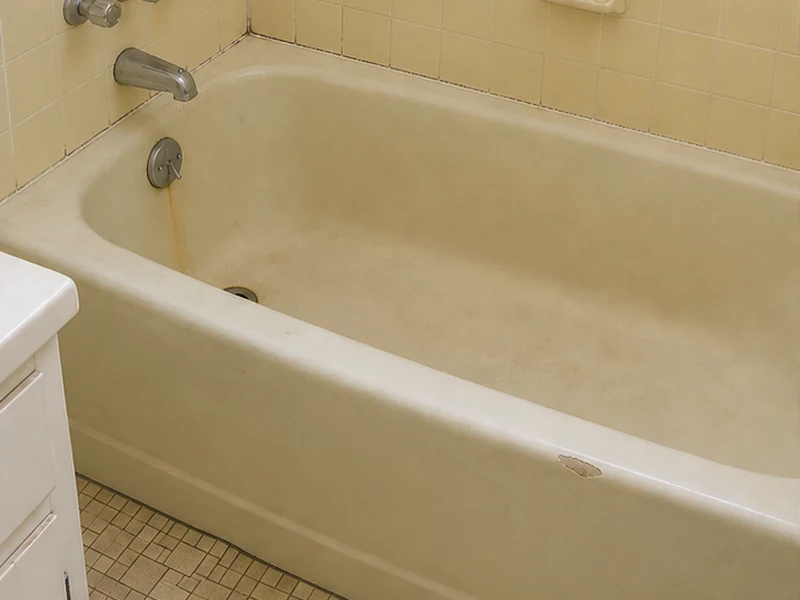
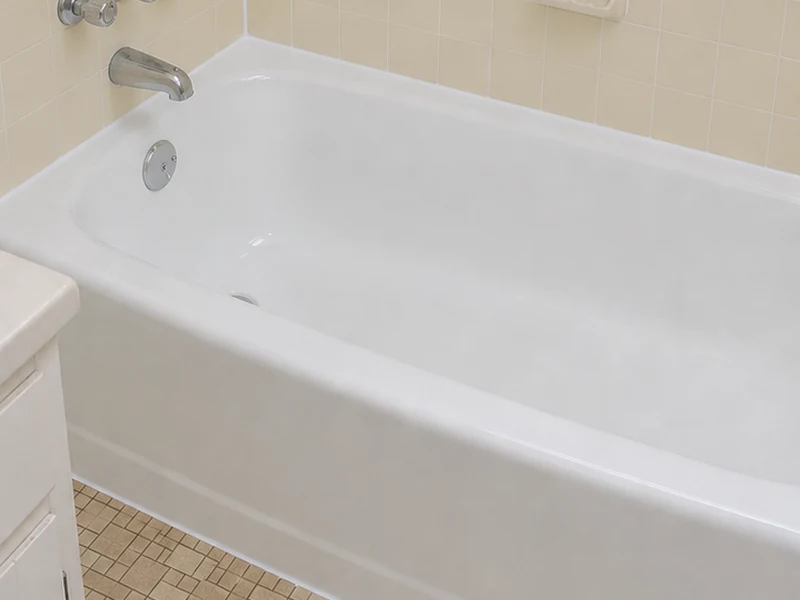
Fremont before & after
Fremont reviews
★★★★★
Our cast-iron tub was almond with rust around the drain. They cleaned it up, repaired it, and reglazed it bright white. Looks like the day it was installed and cost a fraction of a new tub.
— Robert H., Glenmoor
★★★★★
I got a quote to replace our heavy old cast-iron tub and it was wild once you added demo and tile. Reglazing was the obvious call and the finish is glass-smooth.
— Elena V., Mission San Jose
★★★★★
There was a chip on the rim that kept rusting. They filled it, etched the whole tub and sprayed it. You can't find where the chip was anymore.
— James O., Sundale
Porcelain & cast-iron tub FAQ
What's the difference between reglazing, refinishing and resurfacing?
They are three names for the same work: bonding a new coating onto the existing tub rather than replacing it or fitting a liner. On cast iron we acid-etch the porcelain enamel and spray acrylic-urethane to restore a factory-smooth surface.
How do I care for a reglazed cast-iron tub?
Use a non-abrasive cleaner and a soft cloth, skip scouring powders and abrasive pads, and avoid leaving a wet suction-cup mat on the floor. Cared for that way, the reglazed finish keeps its gloss for its full 10–15 year life.
Why do DIY refinishing kits peel off a cast-iron tub?
Hard porcelain enamel is glass-smooth, so a brush-on kit that cannot properly acid-etch it never bonds and lifts within 3–5 years. A real etch, bonding primer and sprayed acrylic-urethane are what keep the finish on for 10–15 years.
Is on-site refinishing as good as factory re-enameling for a built-in tub?
For a fixed alcove tub, yes — and far less disruptive. Re-enameling needs the tub removed and fired in a kiln. On-site refinishing bonds an acrylic-urethane coat right where the tub sits, gives the same smooth glossy surface, and has the tub usable again in 24–48 hours.
How can I tell if my tub is cast iron or steel?
Tap it and try a magnet. Cast iron rings dull and dead and feels very heavy; porcelain-over-steel rings higher and is lighter. A magnet sticks to both but won't grab fiberglass or acrylic. Both metals get the same acid-etch reglazing prep.
Plan the job
Most requested Fremont reglazing pages
Start with the page that matches your fixture, then check the price range, process, project photos and scheduling page. These internal links keep the Fremont service pages connected instead of buried behind the main menu.
Reglaze your Fremont cast-iron tub
Open Mon–Sat 7:30 AM–6 PM. Fully licensed & insured, with a 5-year written warranty.
Call (510) 929-3220 Book online